
Primary service 02
Experts in Complex Commercial Claims & Large Loss Claims
Our consultants support complex losses involving commercial businesses, large municipalities, school districts, governmental entities, county facilities, airports, warehouses and manufacturers.
Overview
What changes when a loss gets large
A large loss is not a small loss with more items in it. Past a certain size the constraint stops being how fast a consultant can record property and becomes whether the record holds together: whether building 4 was counted once and not twice, whether the figure quoted in the third progress report reconciles with the figure in the first, and whether anyone can still answer a question about a specific item ninety days later. US Claims Solutions staffs and structures these assignments so that record survives the length of the claim.
The assignments this page describes are school districts after a storm, municipal and county facilities, airports, distribution networks and manufacturing plants — losses that run weeks rather than days, involve a restoration contractor and often several trades, and are watched by people who did not commission the inventory. What counts as a large loss is defined by complexity and stakeholder count as much as by dollar value.
Method
How a multi-building assignment is held together
01
One scope, agreed before anyone deploys
Building list · Access windows · Trade sequencing · Reporting cadence
Before a consultant arrives, the assignment is scoped building by building: which structures are in, who controls access to each, what the restoration contractor intends to move and when, and how often the carrier wants to hear from us. On a school district that means working around a demolition schedule and a district calendar. Getting this wrong is the most expensive mistake available on a large loss, because a building inventoried after a pack-out has to be reconstructed from someone else’s records rather than observed.
02
Consistent recording across a distributed crew
Shared field conventions · Naming standards · Single reconciliation point
Six consultants across four buildings will produce four different inventories unless the conventions are set first. Item naming, condition vocabulary, location referencing and photograph protocols are fixed at the start, and everything routes through one reconciliation point rather than being merged at the end. This is why the final document reads as one inventory rather than as four stapled together. More on scaling across buildings.
03
Progress reporting while the work is running
Building-level completion · Running totals · Early exposure signals
On an assignment that runs four weeks, a carrier should not wait four weeks to learn what the exposure looks like. Consultants report building-level completion and running totals as the work proceeds, and flag the categories that are running materially above or below expectation early enough for reserves to move. The categories that surprise people are rarely the obvious ones — it is usually stored stock, IT hardware, or contents in spaces nobody walked on the first day.
04
Working alongside the other parties on site
Restoration contractors · Forensic engineers · Public entities · Recovery vendors
Large losses are crowded. Our consultants coordinate with the restoration contractor so the inventory and the pack-out list reconcile, stay clear of areas under forensic examination until released, and work to the access rules a public entity has to follow. US Claims Solutions documents and values property at the direction of the carrier, adjuster or insured; it does not negotiate or settle the claim, which is precisely what lets it work comfortably alongside every other party on the site.
A worked example
A district-wide property loss across multiple campuses
A weather event damaged buildings across a large school district. Several campuses were affected to different degrees, the district needed classrooms back before the academic year, and a restoration contractor was already mobilizing when the assignment came in.
Consultants deployed across the affected facilities and worked campus by campus rather than district-wide, because each campus had its own access window and its own demolition sequence. Classroom contents, library collections, band and athletics equipment, CTE shop machinery, kitchen equipment and IT hardware were inventoried, photographed and identified, with district asset tags recorded where they survived.
The categories that drove the final number were the ones that are easy to walk past: consumable classroom stock held in quantity, science and CTE equipment with real replacement cost and no resale market, and stored seasonal property in spaces that were not on the original building list. Salvage was evaluated in the same pass, and recoverable shop machinery and kitchen equipment went to market rather than to the skip.
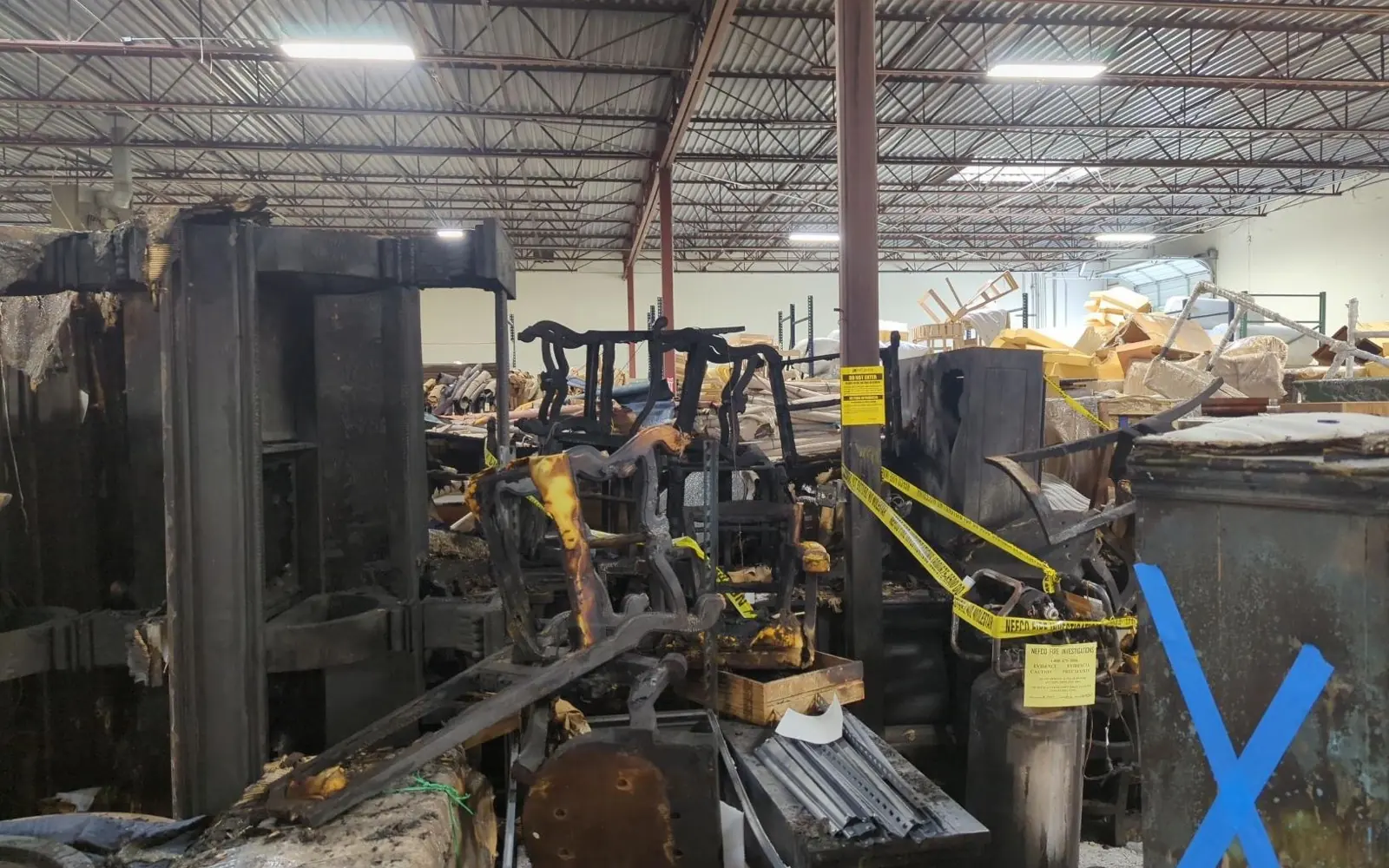
Representative assignment. Clients are not identified without written permission. Photographs are from US Claims Solutions field work and are illustrative of the property class described.
FAQ
Questions that come up on complex losses
Whatever the scope needs, which is agreed before deployment rather than discovered afterwards. Crew size is driven by item density, access windows and the reporting cadence the carrier wants, and it changes over the life of the assignment — more people in the first week, fewer as buildings close out.
No, but the sooner the better. Where a pack-out is already under way, consultants inventory at the restoration facility and reconcile against the contractor’s own records, accepting that location and condition evidence is weaker than it would have been on site. Where it has not started, we work alongside the contractor so both records agree.
Yes. Municipalities, counties, school districts and airports all have access controls, badging requirements and public-records obligations that a commercial site does not. Those are scoped at the start rather than negotiated in the field.
Every line is tied to a photograph, a location and an identification, and the reconciliation point is a single document rather than a merge of several. A number that can be traced back to an item in a room in a building does not move; a number that came from a subtotal does.
Related reading
Go deeper on this
Have a loss with several buildings involved?
Tell us how many structures and who else is already on site. We will scope the assignment on the call and can deploy a crew within hours.
Last updated